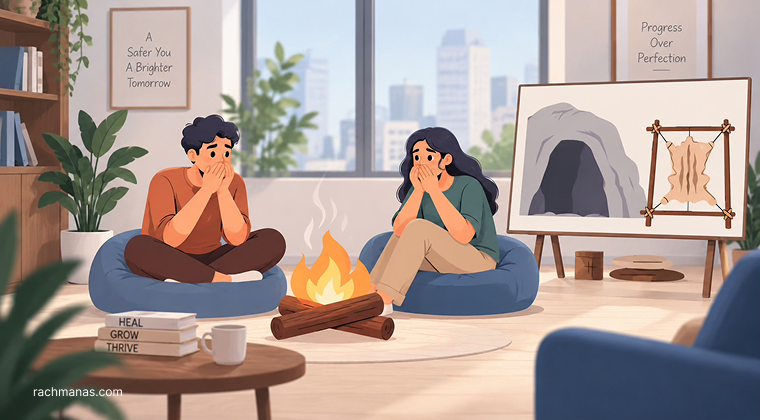
What if some of the things we call personality, instinct, bias, ambition, jealousy, risk-taking, or even gossip are not entirely products of modern life?
That is the provocative question at the heart of Nigel Nicholson’s 1998 Harvard Business Review article, How Hardwired Is Human Behavior?
Nicholson, then Professor of Organizational Behavior and Dean of Research at London Business School, presented evolutionary psychology as an emerging framework for understanding why modern humans may still carry psychological tendencies shaped in very different environments.
The central idea was simple, but rather uncomfortable: our environment has changed dramatically faster than our basic psychological machinery may have changed.
The Stone Age mind in the modern office
Evolutionary psychology argues that natural selection shaped not only the human body but also aspects of the human mind. Nicholson described humans as carrying mental tendencies inherited from hunter-gatherer ancestors, including sensitivity to threats, loss aversion, status-seeking, social classification, cooperation and information-sharing.
Why would these tendencies survive?
The argument is evolutionary. Behaviours that helped ancestors survive and reproduce were more likely to persist across generations. Nicholson drew on six areas of research to explain the emerging field: anthropology, behavioral genetics, comparative ethology, neuropsychology, paleontology and social psychology.
This was not, however, an experiment conducted by Nicholson. His article was a synthesis of research and theory available at the time. That distinction matters.
What evidence supported the idea?
The article pointed to twin and adoption research in behavioral genetics, cross-cultural observations in anthropology, primate studies, brain research and social experiments examining cooperation, aggression and competition. Researchers were looking for patterns that appeared repeatedly across populations and species.
One striking example was Robin Dunbar’s work on primate brains and social group size. Nicholson connected Dunbar’s research with the idea that humans may have cognitive limits on maintaining close social relationships, with groups of around 150 becoming particularly significant.
The article then took these findings into the workplace. Why do employees resist change? Why do people react more strongly to losses than equivalent gains? Why do informal hierarchies emerge even when organisations attempt to flatten them? Why does office gossip survive despite endless corporate communication?
Nicholson’s answer was that some of these behaviours may have deep evolutionary roots.
Thirty years later, has the picture changed?
Yes, considerably.
Contemporary evolutionary research is less comfortable with a simple “genes versus environment” story. Research now increasingly examines gene-culture interaction, showing that culture can itself alter the environments in which selection operates. Researchers have argued that human evolution has been shaped by reciprocal interactions between genetic and cultural processes.
Research published in 2025 also emphasises the extraordinary role of human culture in generating and transmitting behavioural variation. Rather than treating culture as a thin layer sitting on top of biology, contemporary researchers increasingly examine how biological, social and cultural processes interact.
Even emotion, once frequently treated as primarily biological, is now being examined through cultural-evolutionary frameworks. A 2022 Nature Reviews Psychology perspective argued that biology and culture should not be treated as opposing explanations and highlighted evidence for cultural variation in how emotions are understood and expressed.
That makes Nicholson’s original question even more interesting.
Perhaps the issue is not whether humans are “hardwired.”
Perhaps it is how much biology, learning, culture and environment continuously shape one another.
The ethical problem: explanation can become excuse
This is where the subject becomes socially sensitive.
If aggression, status-seeking or gender differences are described as evolutionary, could people start treating them as inevitable? If leadership ability is described as innate, could organisations use biology to justify exclusion?
Nicholson himself acknowledged that evolutionary psychology was controversial, particularly because critics believed it could overstate biological explanations while underestimating learning, language and culture.
That concern remains important.
An evolutionary explanation can describe a tendency without declaring a destiny. Modern research also supports the idea that humans continue to evolve and that human nature is dynamic rather than frozen in the past.
There is another ethical issue today: genetic information can be misused when probabilities are mistaken for prescriptions. A biological predisposition does not tell us what an individual will do.
So, how hardwired are we?
Nicholson’s 1998 article offered a provocative answer: quite hardwired.
Three decades of research suggest a more nuanced one.
Humans may carry evolved psychological tendencies. Yet those tendencies operate inside families, cultures, institutions, technologies and changing environments. Contemporary cultural psychology increasingly treats culture as dynamic rather than as a fixed national personality, while evolutionary research increasingly examines biological and cultural processes together.
That leaves us with a more useful question.
Not “Can human nature change?”
But “What happens when an ancient psychological system meets a radically modern world?”
That question still has plenty of life left in it.