
Helping a Student Move Beyond Erratic Behaviour to Emotional Stability
How student counseling helped a Delhi NCR teenager manage emotional outbursts, academic pressure and erratic behaviour while building stability.
 Rachmanas Counseling
How student counseling helped a Delhi NCR teenager manage emotional outbursts, academic pressure and erratic behaviour while building stability.
Rachmanas Counseling A 15-year-old Class X student from a private school in Delhi NCR was referred for student counseling after a noticeable change in behaviour at home and school.
Until recently, he had been a fairly consistent student. His grades were good. He usually followed routines and had a comfortable relationship with his parents and teachers. Over several months, however, his behaviour became harder to predict.
At home, small requests could lead to sharp replies or an argument. Study time often became a point of conflict. Some days he would sit down and work for hours; on others, he avoided his books altogether. After an argument, he often withdrew and stayed quiet.
His teachers noticed a similar change. He sometimes participated well in class, but at other times appeared distracted or unusually quiet. He had also started reacting more strongly when corrected.
His parents saw this as a worrying decline in discipline. The student saw it differently. He felt that everyone was watching his studies but nobody was asking what was making things difficult.
This became the starting point for student counseling. The aim was not simply to make him more compliant. It was to understand what had changed and why his behaviour had become his main way of expressing it.
The first few sessions focused on understanding the pattern rather than assigning a label.
The assessment included the Personal Information Questionnaire, individual conversations with the student, parent interviews, teacher feedback, and mapping of situations that usually preceded an outburst or withdrawal.
Academic expectations, family interactions, sleep and routine, emotional awareness, and coping habits were also explored. Broader emotional concerns were screened where appropriate.
A clear cycle began to emerge.
A reminder about studies often led to the thought, “They think I am not doing enough.” That thought increased frustration. Frustration led to an angry response. The parents then became more watchful. Their increased attention felt like more pressure to the student, and the cycle started again.
The concern was therefore not simply poor discipline. The student had difficulty recognising emotional build-up early enough to manage it. He also had limited ways to explain what he was feeling.
This formulation drew on CBT, particularly the relationship between thoughts, emotions and behaviour. CBT has strong evidence across a range of psychological difficulties, including problems involving stress, anger and emotional distress in young people (Butler et al., 2006; Hofmann et al., 2012). (PubMed)
The broader work also considered emotion regulation. Gross’s process model describes several points at which people can influence an emotional response, including attention, interpretation and response modulation (Gross, 1998). (DOI)
The first task in student counseling was to make the sessions feel different from school and home.
The student was not asked to defend every behaviour. Instead, the focus was on what happened before, during and after difficult moments. This helped reduce the usual pattern of adult questioning followed by teenage resistance.
The central question became simple: “What happens just before things go wrong?”
That question produced more useful information than repeated questions about why he was behaving badly.
The work followed a collaborative approach. The student helped identify which situations felt difficult and which changes seemed realistic.
This matters because psychotherapy outcomes are influenced not only by specific techniques but also by the working relationship and the wider context in which change takes place (Wampold & Imel, 2015). (Routledge)
The next stage of student counseling used a simple CBT chain:
Trigger → Thought → Feeling → Behaviour → Consequence
For example:
Parent asks about homework → “I am already behind” → frustration → sharp reply → argument → loss of study time
Once this pattern became visible, the student could see that the argument was not the beginning of the problem. It was the end of a chain that had started earlier.
He then learned to identify early signs such as physical tension, restlessness, repeated negative thoughts and the urge to answer immediately.
The aim was not to remove anger. It was to create a small gap between feeling angry and acting on it.
Academic setbacks often triggered thoughts such as, “I have messed up everything,” or, “If I cannot do this properly, there is no point starting.”
These thoughts were examined through CBT-based questioning. What exactly had gone wrong? What evidence supported the conclusion? What would he say if a friend made the same mistake?
The student began replacing global judgements with more specific statements. “I did badly in this test” was different from “I am bad at studies.”
This distinction sounds small. In practice, it changed how quickly frustration turned into avoidance. Reviews of CBT research have found substantial support for CBT across many psychological problems, including general stress and anger-related difficulties (Hofmann et al., 2012). (PubMed)
The student was taught short regulation exercises that he could use before an emotional response became too strong.
These included paced breathing, brief grounding, noticing physical sensations, and taking a deliberate pause before replying during conflict.
Mindfulness was introduced in a practical way rather than as a long meditation exercise. The student practised noticing, “I am getting angry,” instead of immediately becoming the anger.
Research on mindfulness-based approaches has found moderate benefits across several psychological difficulties, including stress, anxiety and depression (Khoury et al., 2013). (PubMed)
Student counseling could not work well if every improvement in the student was followed by increased monitoring at home.
Parent sessions therefore focused on changing the interaction around studies.
The parents were encouraged to reduce repeated checking, separate academic discussions from ordinary family conversations, and avoid turning every disagreement into a lesson about responsibility.
They still maintained clear limits. The change was in how those limits were communicated.
Instead of asking several times, “Have you studied? How much? What did you finish?”, the parents began agreeing on a study window and allowing the student some ownership within it.
The final stage of student counseling focused on moving responsibility back to the student.
He began tracking a few simple behaviours: starting work on time, noticing emotional triggers, using a regulation strategy, and returning to the task after a setback.
The goal was not perfect behaviour. It was recovery.
A difficult moment no longer had to ruin the entire evening.
Over 12 sessions across four months, the pattern became more stable.
The frequency and intensity of emotional outbursts reduced. The student became better at noticing when frustration was building and was more willing to take a short break rather than continue an argument. He also became more comfortable putting feelings into words.
One of the more useful changes was seen after academic setbacks. Earlier, a poor test could lead to avoidance for the rest of the day. Later, he was more likely to acknowledge the disappointment, identify what had gone wrong and return to the task.
His parents also reported fewer arguments around study routines. They became less likely to interpret every difficult response as deliberate defiance.
Teacher feedback suggested more consistent classroom participation and fewer argumentative responses to correction.
There were still difficult days. Emotional regulation did not become automatic, and exam pressure continued to affect him at times. But the recovery time became shorter.
That was a meaningful measure of progress in student counseling. Emotional stability did not mean that the student stopped becoming angry, frustrated or disappointed. It meant those emotions no longer controlled the rest of his day.
The family had moved from:
Correction → Resistance → Conflict → Withdrawal
towards:
Recognition → Communication → Regulation → Responsibility
This case has been anonymised, and identifying details have been changed to protect privacy. Work with a minor requires careful attention to consent, confidentiality, parental involvement and the young person’s developing autonomy.
Information was shared with parents and school only within appropriate professional boundaries. The counselor’s role was to understand the student’s experience without taking sides or reducing the child to a behaviour problem.
These principles are consistent with the APA Ethics Code’s emphasis on professional responsibility, confidentiality and respect for people’s dignity and rights (American Psychological Association, 2017). (American Psychological Association)
In student counseling, parents often arrive with a simple description: “My child has changed.”
Sometimes that is exactly what has happened. But behaviour rarely arrives without a story behind it.
A teenager preparing for board examinations may be carrying academic expectations, fear of disappointing parents, pressure from school and a growing need for independence, all at the same time.
In many Delhi NCR families, concern about a child’s future can quietly become constant supervision. The intention is care. The effect can sometimes feel like pressure.
The important shift in this case was from asking, “How do we stop this behaviour?” to asking, “What is this behaviour telling us?”
That question changed the work.
Good student counseling does not aim to produce a perfectly obedient teenager. It helps a young person understand emotions, handle frustration, communicate more clearly and take responsibility for choices. Parents remain parents.
Teachers remain teachers. The student simply gains a little more room to think before reacting.
And sometimes that small pause is where stability begins.

 Turning Workplace Strain Into Stronger Team Dynamics and Collaboration
 A 36-year-old mid-level manager from Delhi NCR sought workplace adjustment counseling after noticing that work…
 Guiding a Parent Through Academic Conflict Towards Constructive Communication
 The mother was beginning to notice an uncomfortable contradiction. She knew almost everything about his…
 Trapped in Comparison: How Exam Pressure Turns Effort into Self-Doubt
 A case study on comparison anxiety; learn how therapy improves focus, reduces stress, and builds…
 When the Break Feels Worse Than the Work: Rest, Guilt, and the Exhausted Mind of an Exam Aspirant
 A case study on productivity guilt, burnout, and how one aspirant learned that rest is…
 The Quiet Distance: When a Marriage Feels Stable but Empty Inside
 A marital counseling case study on intimacy issues in long-term Indian marriages; how EFT and…
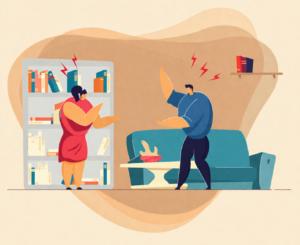 Who Gets the Final Say? When Decisions Become Battles for Respect
 A marital counseling case study on decision-making conflict in Indian couples; how EFT and Gottman…
We've sent a 4-digit OTP to your number ending in XXXXXX1234. Please enter it below to continue.

Thank you for registering. Check your WhatsApp for the next steps.

It looks like you already have an account with these details. Please try registering with a different number. If you’ve attended a session with us before, reach out at support@rachmanas.com.


Tell us a little about you so
we can guide you better

Your privacy is important to us. We're here to support you.