
CBT Made Simple: Rewiring Your Mind, One Thought at a Time
In this guide, we’ll unpack CBT for anyone curious, share a real client story, and offer tools to start rewiring your mind, no psych degree required.
 Rachmanas Counseling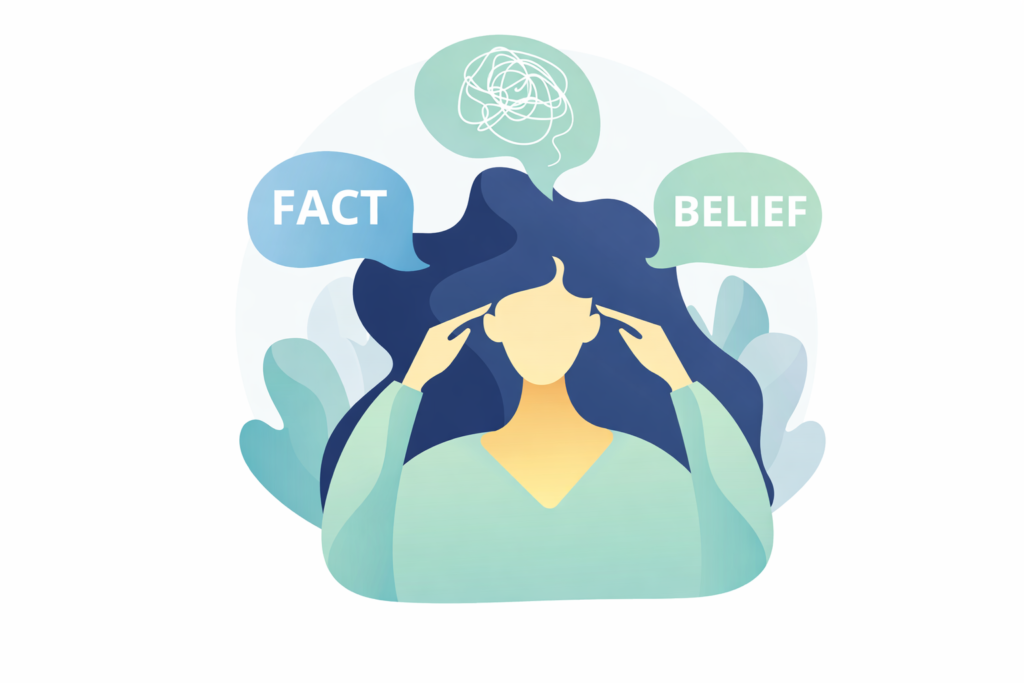
In this guide, we’ll unpack CBT for anyone curious, share a real client story, and offer tools to start rewiring your mind, no psych degree required.
Rachmanas Counseling Last week, we sat with a client, a father, who described his life as a “mental hamster wheel.” At 40, he was juggling a demanding job, two young kids, and a marriage strained by constant bickering.
“I keep thinking I’m failing everyone,” he confessed, his shoulders slumped. “And I can’t stop the worry—it’s exhausting.” That relentless cycle of negative thoughts? It’s not just you—it’s your brain’s default setting, and it’s fixable. Enter Cognitive Behavioral Therapy (CBT). Think of CBT as a masterclass in mental resilience—practical, structured, and empowering.
In this guide, we’ll unpack CBT for anyone curious, share a real client story, and offer tools to start rewiring your mind, no psych degree required.
CBT is built on a simple truth: your thoughts, emotions, and behaviors are interconnected, like a family at a tense dinner table. Negative thoughts (“I’m a failure”) spark bad feelings (anxiety, sadness) and unhelpful actions (avoiding, lashing out).
CBT teaches you to interrupt that cycle and rewrite the script. It’s rooted in decades of research showing that distorted thinking patterns drive 90% of anxiety and depression cases. Here’s how it works, grounded in neuroscience:

CBT is a lifeline for anyone caught in their head’s drama. Parents battling stress and self-doubt. Teens wrestling with social fears or academic pressure. Couples trapped in conflict loops, snapping over dishes or date nights.
Older adults facing loneliness or health anxieties. Our work with families across generations—kids, couples, grandparents—shows CBT’s versatility. If you’re tired of overthinking, avoiding challenges, or feeling stuck, CBT’s structured approach can help. It’s not about “fixing” you—it’s about equipping you to navigate life’s messiness with clarity.
The father we mentioned, booked a life stress counseling session with us, overwhelmed by anxiety. A tech manager, he was haunted by thoughts of failing at work and home. “I’m letting my kids down, my wife down, everyone,” he said. His sleep was shot, he avoided team meetings, and he and his wife argued daily.
His story mirrors many we’ve seen in my work with families.We started with CBT’s core tool: thought records. The client logged his worry: “I’ll mess up this project, and I’ll get fired.” He rated its intensity (85/100) and listed evidence.
Against: “I got a promotion last year; my team respects me.”
For: “I missed a deadline last month.”
This exercise dropped his worry to 50/100, as he saw the thought wasn’t ironclad. Research shows thought records reduce anxiety by 25% in early sessions. Next, we used cognitive restructuring. He reframed “I’ll mess up” to “I might stumble, but I’ve handled tough projects before.” We practiced behavioral experiments: he prepared one slide daily for his next presentation and used slow breathing to stay calm.
We also taught him exposure techniques, gradually facing meetings instead of dodging them. After 12 weeks, the client’s anxiety fell by 65% (his number, not ours), and he delivered a killer presentation.
The wife noticed he was more patient at home, even joking during dinner. His progress aligns with studies showing CBT cuts anxiety symptoms by 50-70% in 8-16 sessions. The client didn’t become worry-free—he became a worry-tamer.
Ready to test-drive CBT? These three techniques, drawn from our practice and backed by science, are simple enough for beginners:
Thought Tracker: Catch a negative thought (“I’m going to bomb this”). Write it down, rate its strength (1-100), and list three pieces of evidence against it. This reduces distortion-driven stress by 20% in weeks).
Example: “I bombed last time” vs. “I’ve done well before, and I’m prepared.”
Friend Test: Imagine a friend has your worries. What advice would you give? This shifts perspective, cutting emotional intensity by 15%.
Say: “You’re not a failure—you’re learning.”
Action Step: Pick one small task tied to your fear (e.g., reply to a tough email). Do it, and notice how you feel. Action boosts dopamine, lifting mood by 10%.
CBT is powerful, but it’s not a one-size-fits-all fix. It requires effort—think 8-20 sessions, with 60% of clients needing consistent practice for lasting change (Butler et al., 2006).
If you’re grappling with trauma, severe depression, or complex issues, CBT may need partners like medication or deeper therapies (e.g., EFT for couples).
Your brain’s wiring—shaped by culture, genetics, and life—impacts progress. In our work with Indian families, we’ve seen how cultural values influence thought patterns, requiring tailored approaches.
Don’t expect instant Zen, and if you’re stuck, a therapist can customize CBT to you. Self-help tools are great starters, but a pro’s guidance is like having a personal trainer for your mind. If negative thoughts creep back, that’s normal—CBT’s about progress, not perfection.
Our client’s story, like those of countless clients we’ve supported, shows CBT’s magic: it’s not about erasing life’s challenges but empowering you to face them with skill. Your mind’s not a runaway train—you can steer it.
With so many people seeing anxiety and depression ease through CBT, it’s a tool worth exploring.
Start small: try a thought tracker, test an action step. In our years of guiding families through life’s ups and downs, we’ve seen CBT turn worry into resilience, one thought at a time. Your brain’s ready for the challenge—grab the reins and start rewiring today.

 Were Your Childhood Cartoons Secretly Shaping Your Personality? Research Raises a Fascinating Question
 Could the cartoons we watched as children leave traces in the way we trust, communicate,…
 How Hardwired Is Human Behavior? What Evolutionary Psychology Got Right, Wrong, and Still Makes Us Ask
 What if some of the things we call personality, instinct, bias, ambition, jealousy, risk-taking, or…
 How Much of Your Success Is Actually You? New Genetic Study Puts Personality Under the Microscope
 What if the person who seems naturally organised, ambitious and persistent is not simply “more…
 Can You Really Trust What You Remember? Understanding Memory Reconsolidation
 A clinical research review prepared for the Rachmanas editorial library.
 The Guilt That Stays: What Dostoevsky Understood About the Conscience
 Dostoevsky's Raskolnikov shows what guilt does when unresolved. Explore the psychology of conscience and rationalization,…
 Your Brain Has a Cholesterol Problem… In a Good Way.
 Is cholesterol really the villain we think it is? Explore the surprising role cholesterol plays…
We've sent a 4-digit OTP to your number ending in XXXXXX1234. Please enter it below to continue.

Thank you for registering. Check your WhatsApp for the next steps.

It looks like you already have an account with these details. Please try registering with a different number. If you’ve attended a session with us before, reach out at support@rachmanas.com.


Tell us a little about you so
we can guide you better

Your privacy is important to us. We're here to support you.